
Private Label / OEM
Use a mature formula platform with your branding, flavor and packaging. This is usually the fastest and lowest-risk route to market.
Custom Formulation
Develop ingredient systems, film dimensions, sensory profile and packaging around your positioning and target market.
Sampling & Optimization
Bench samples are assessed for appearance, handling, disintegration, taste and dose distribution before scale-up.
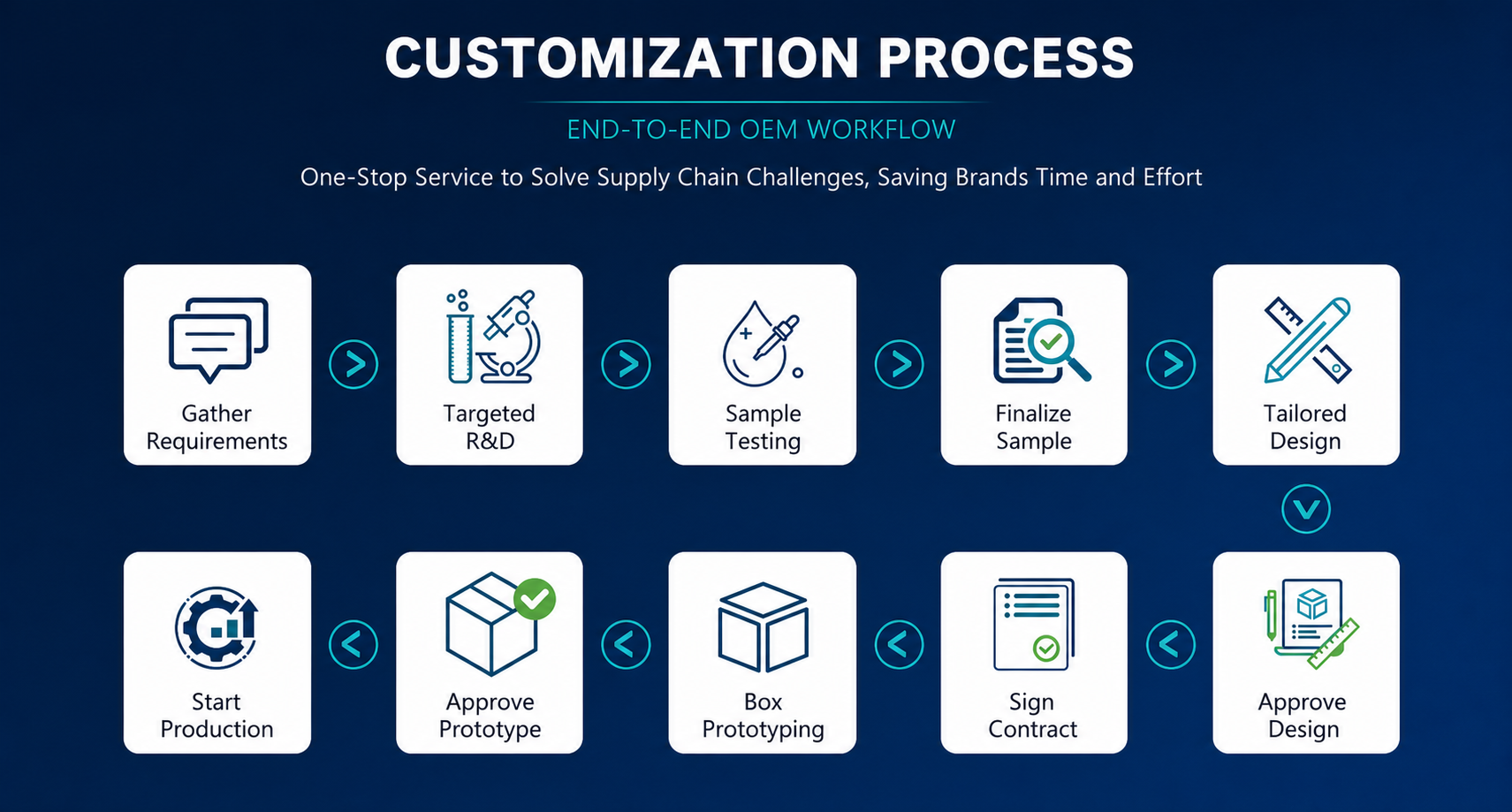
End-to-End Development Workflow
Project brief and regulatory screen
Target market, consumer, claims, actives, dosage, format, price point and annual volume are clarified.
Feasibility and quotation
We assess active loading, ingredient compatibility, film area, taste masking, MOQ, tooling and packaging needs.
Lab sample and sensory refinement
Film-forming polymer, plasticizer, flavor, sweetener and process window are adjusted to the concept.
Pilot, testing and artwork review
Scale-up trials, specification setting, packaging compatibility and market-specific label checks support launch readiness.
Commercial manufacturing
Controlled mixing, casting, drying, slitting, unit-dose packing and finished-product release are completed to the agreed specification.
Packaging & Format Options
| Element | Typical options | Why it matters |
|---|---|---|
| Unit dose | Individual foil sachet | Moisture, oxygen, hygiene and portability protection |
| Retail count | 10 / 20 / 30 strips per box | Aligned to use occasion and price point |
| Secondary pack | Printed carton or tin | Branding, instructions and market information |
| Film | Thickness, dimensions, color, translucent or opaque | Controls loading, handling and consumer experience |
MOQ Principles
Mature formulas generally support lower entry quantities than a new formulation. Custom ingredients, high active loading, unusual flavors, printed sachet minimums, testing requirements and destination-market documentation can increase the practical MOQ. We quote against a complete project brief rather than advertise a misleading universal minimum.
A nine-stage route from brief to dispatch
The updated brochure organizes customization into nine commercial and technical stages. Approve the formula and sample before locking the order, then use the contract to define payment, manufacturing, packing, dispatch and after-sales responsibilities. At development, confirm ingredient source, intended loading, film dimensions, flavor, sensory limits and unit-dose packaging together. This prevents a visually attractive sample from being mistaken for an approved, shelf-stable commercial product. Testing plans, artwork approval and acceptance criteria should be documented before scale-up.
- 01Requirements discussion
Define market, audience, ingredients, loading, flavor and packaging.
- 02Formulation approval
Agree the formula direction and feasibility checks.
- 03Sample approval
Evaluate taste, handling and the proposed specification.
- 04Order confirmation
Confirm SKU scope, artwork, quantity and written terms.
- 05Deposit payment
Follow the agreed commercial contract.
- 06Manufacturing
Produce against approved specifications and controls.
- 07Balance payment
Follow the payment milestones in the contract.
- 08Packing & dispatch
Confirm packaging, shipment and required documents.
- 09After-sales service
Track delivery and review quality feedback.
MOQ, packaging and project planning
For a custom oral film brief, the current planning reference is 5,000 boxes per SKU with 20 strips per box. Custom samples are typically planned at 10–14 working days, followed by 25–35 working days for bulk production after sample approval and final artwork confirmation. These custom-project timings take precedence over a generic standard-order statement in a company brochure. Confirm the actual schedule in the quotation and contract, particularly when ingredient sourcing, analytical methods, stability work or custom packaging requires additional time.
- MOQ5,000 boxes per SKU
- Reference pack20 strips per box
- Custom samples10–14 working days
- Bulk production25–35 working days after sample approval and final artwork confirmation
Supplier-confirmed custom-project planning references, not guaranteed dispatch dates. Formula complexity, material availability, validation and packaging may change the schedule. Printing, development, sample and freight costs are quoted separately; no public price is implied.
Flavor customization starts with the active ingredients
Fruit, mint and blended profiles provide a starting vocabulary for the sensory brief. Finished taste also depends on the active ingredient, its loading, sweetness, cooling strength, acidity and film base. Ask for a sample in the intended formula rather than approving an isolated flavor. The brochure provides fruit and mint examples plus blended directions for different audiences and markets. Final artwork should describe the approved flavor accurately and disclose allergens or other required statements for the destination market.
Bright fruit profiles
Lemon, mango, strawberry, blueberry, lychee, grape, peach, passion fruit and citrus.
Fresh & cooling profiles
Cool mint, spearmint, peppermint, wintergreen, herbal mint and menthol directions.
Layered custom profiles
Lemon & mango, strawberry & kiwi, blueberry & sour raspberry, pineapple & coconut, and fruit-mint blends.
Examples from brochure pages 28–29; the brochure references 100+ flavor directions. Final taste, cooling strength, sweetener system, allergens and market eligibility are approved on the actual formula, not from a flavor name alone.